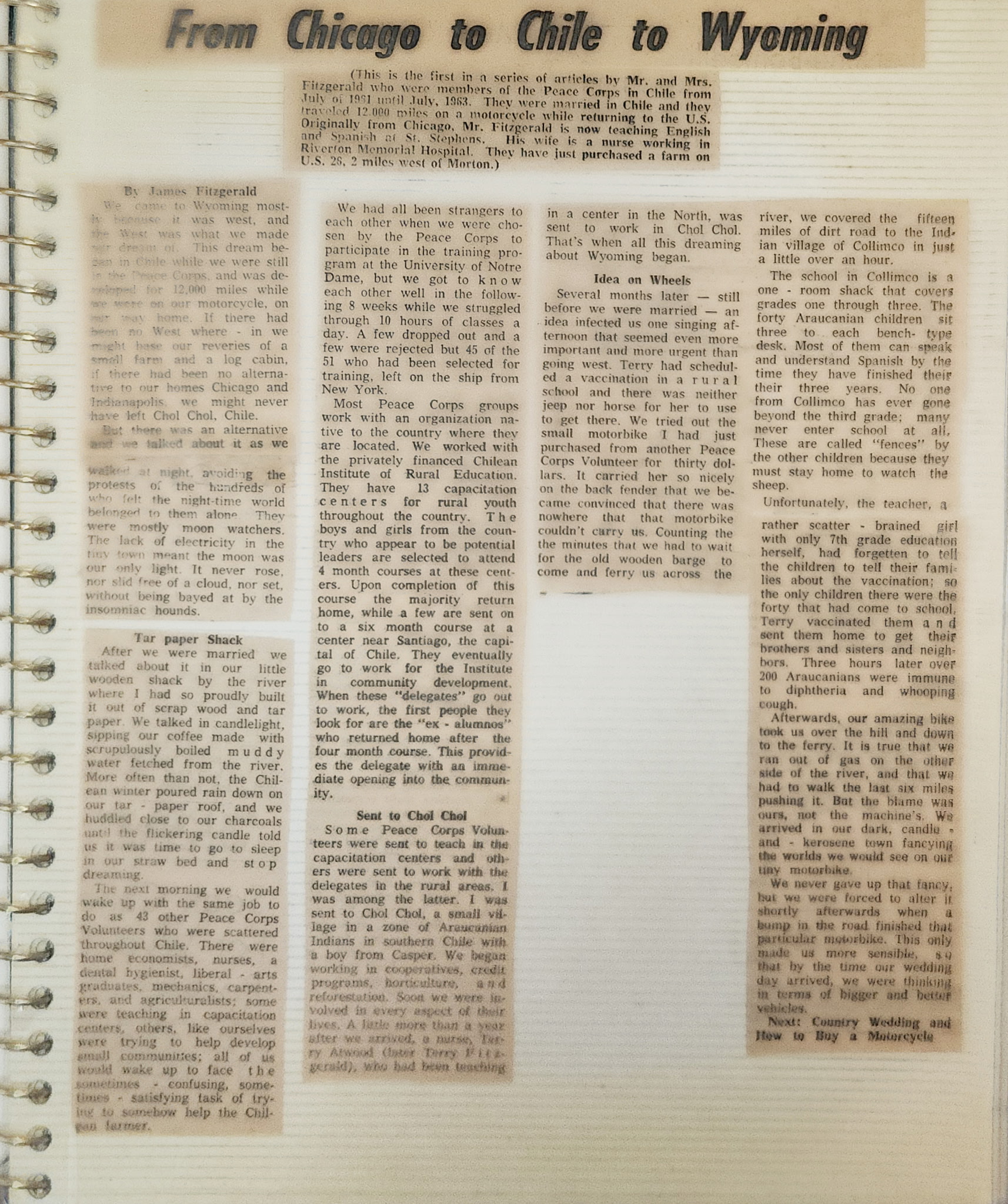
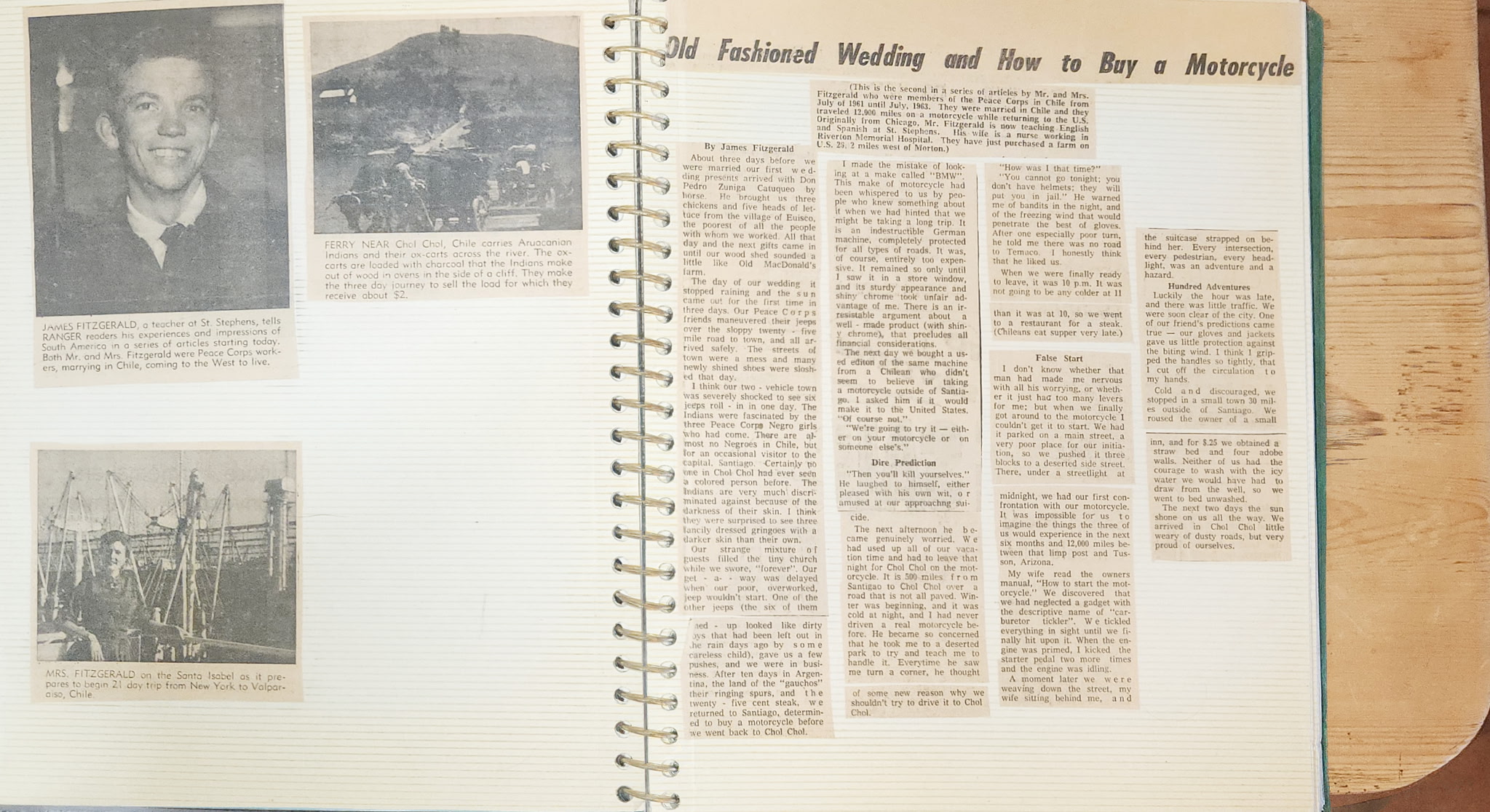
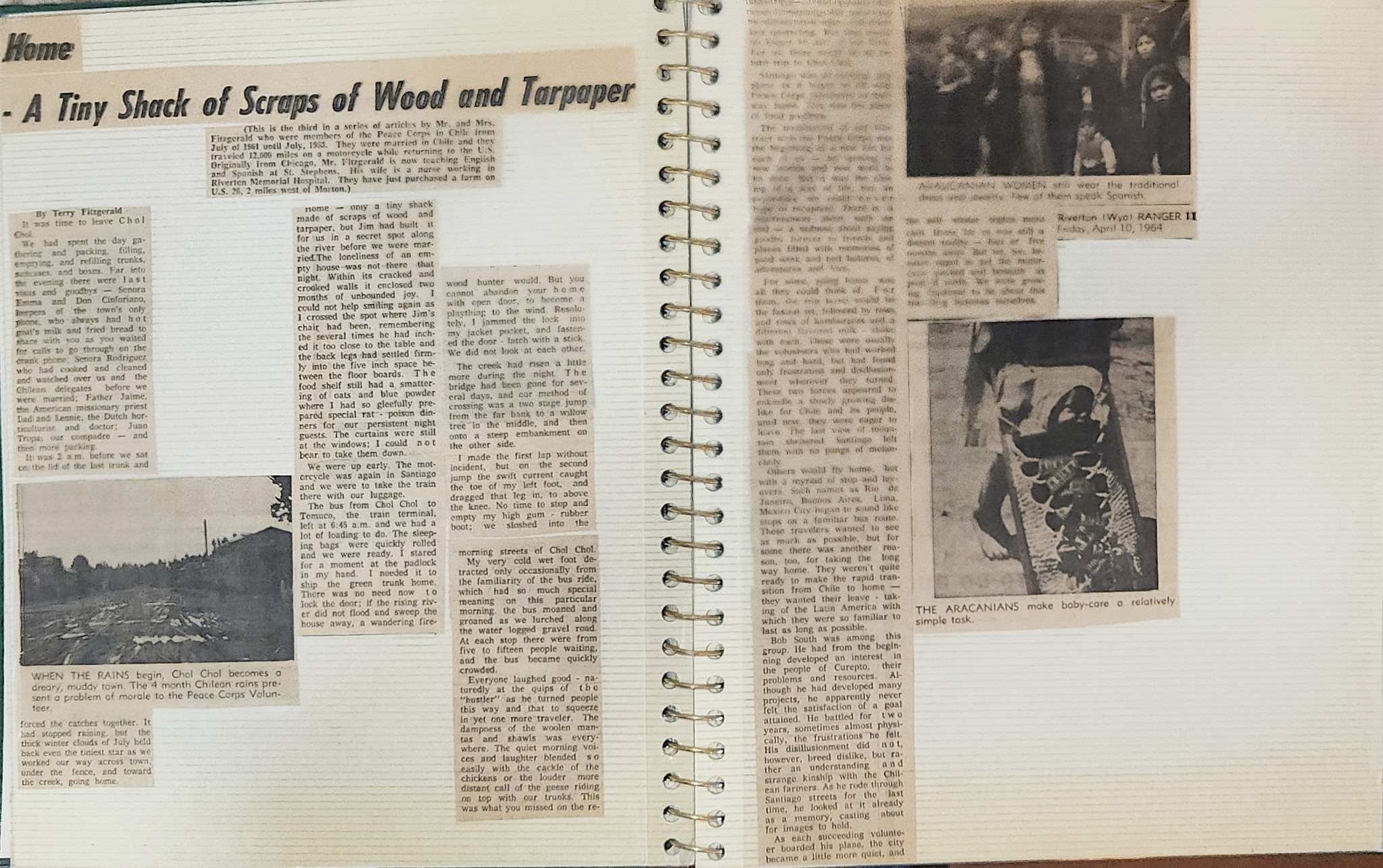
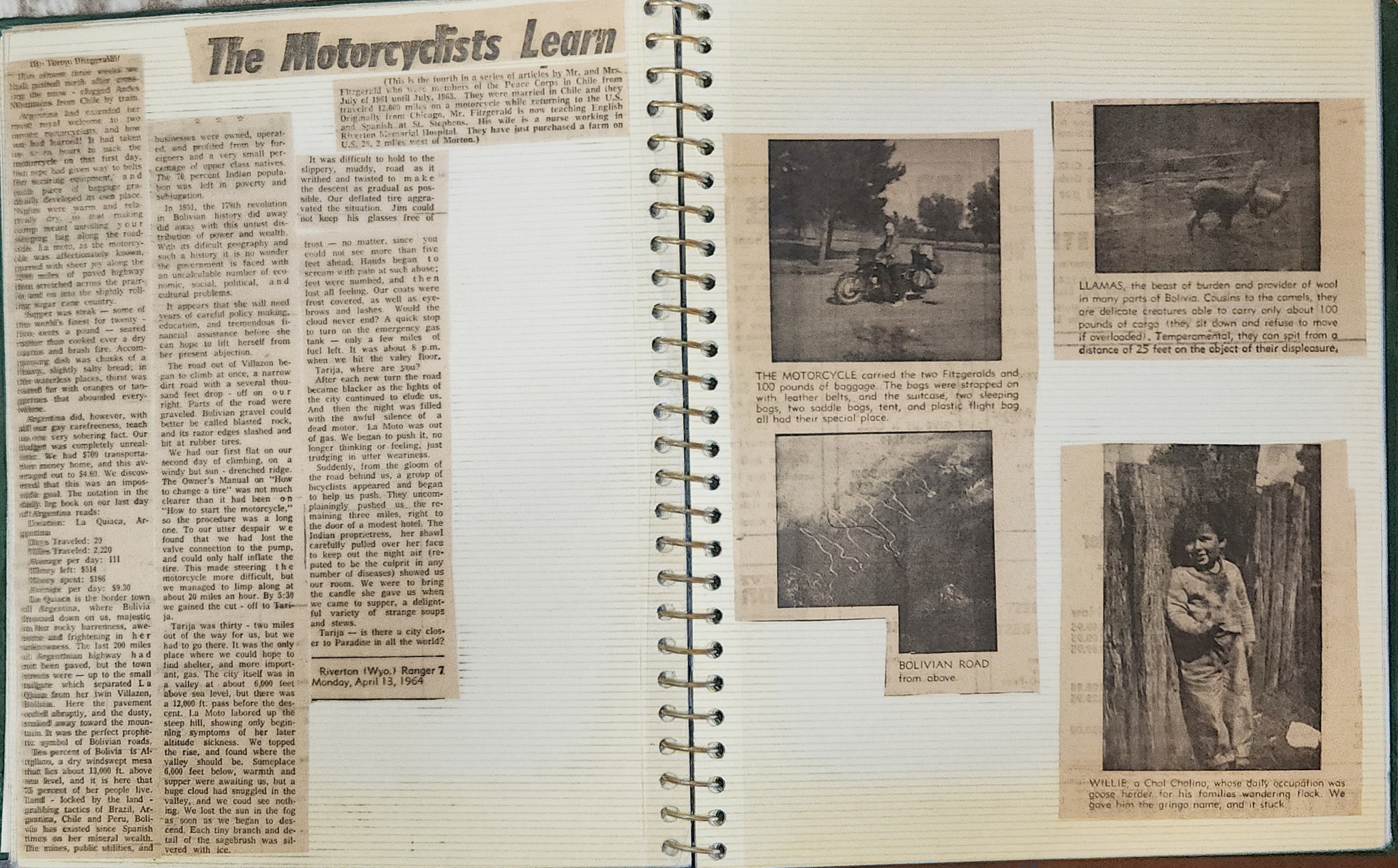
Jim & Terry Fitzgerald's story—from meeting as Peace Corps volunteers to their 12,000-mile
motorcycle journey from Chile to Wyoming—as told
in newspaper articles originally published in the Riverton (Wyoming) Ranger, April 1964.
Peace Corps volunteers find love in a tar paper shack, dream of the American West, and
discover that a thirty-dollar motorbike can take you anywhere.
By: James Fitzgerald (as printed)Article 1
We came to Wyoming most because it was west, and the west was what we made our dream of. This
dream
began in Chile,
while we were still Peace Corps, and was developed for 12,000 miles while we were on our
motorcycle,
on our way home.
If there had been no West where—in we might have our reveries of a small farm and a log cabin,
if
there had been no alternatives to our homes Chicago and Indianapolis, we might have settled for
we
might never have left Chol Chol, Chile. But there was an alternative, and we talked about it as
we
walked at night, avoiding the protests of the hundreds of dogs who felt the
night-time world belonged to them alone. They were mostly moon watchers.
The lack of electricity in the tiny town meant the moon was
our only light. It never rose, nor slid free of a cloud, nor set, without being bayed at by the
insomniac hounds.
Tar Paper Shack
After we were married we talked about it in our little wooden shack by the river. It had so
proudly
been built out
of scrap wood and tar paper. We talked in candlelight, sipping our coffee and muddy water
fetched
from the river.
More often than not, the Chilean winter poured rain down on our tar paper roof, and we huddled
close
to our charcoal
until the flickering candle told us it was time to go to sleep on our straw bed and stop
dreaming.
The next morning we would wake up with the same job to do as 43 other Peace Corps Volunteers who
were scattered
throughout Chile. There were home economists, nurses, a dental hygienist, liberal arts
graduates,
mechanics,
carpenters, and agriculturalists. Some were teaching in capacitation centers; others, like
ourselves, were trying to
help develop small communities. All of us would wake up to face the sometimes confusing,
sometimes
satisfying task
of trying to somehow help the Chilean farmer.
We had all been strangers to each other when we were chosen by the Peace Corps to participate in
the
training
program at the University of Notre Dame, but we got to know each other well in the following
eight
weeks while we
struggled through ten hours of classes a day. A few dropped out and a few were rejected, but 45
of
the 51 who had
been selected for training left on the ship from New York.
Most Peace Corps groups work with an organization native to the country where they are located.
We
worked with the
privately financed Chilean Institute of Rural Education. They have 13 capacitation centers for
rural
youth
throughout the country. The boys and girls from the country who appear to be potential leaders
are
selected to
attend four-month courses at these centers. Upon completion of this course the majority return
home,
while a few are
sent on to a six-month course at a center near Santiago, the capital of Chile. They eventually
go to
work for the
Institute in community development.
When these “delegates” go out to work, the first people they look for are the “ex-alumnos” who
returned home after
the four-month course. This provides the delegate with an immediate opening into the community.
Sent to Chol Chol
Some Peace Corps Volunteers were sent to teach in the capacitation centers and others were sent
to
work with the
delegates in the rural areas. I was among the latter. I was sent to Chol Chol, a small village
in a
zone of
Araucanian Indians in southern Chile, with a boy from Casper. We began working in cooperatives,
credit programs,
reforestation, and community projects. Soon we were involved in every aspect of their lives.
Original clipping scan.
A little more than a year later we were married, and I met my wife, Terry Fitzgerald, who had
been
teaching in a
center in the north, and was sent to work in Chol Chol. That’s when all this dreaming about
Wyoming
began.
Idea on Wheels
Several months later—still before we were married—an idea infected one us during an afternoon
that
seemed even more
important and more urgent than going west. Terry had a scheduled vaccination in a rural school
and
there was neither
jeep nor horse for her to use to get there. We tried out the small motorbike I had just
purchased
from another Peace
Corps Volunteer for thirty dollars. It carried her so nicely on the back fender that we became
convinced that there
was nowhere that that motorbike couldn’t carry us.
Counting the minutes that we had to wait for the old wooden barge to come and ferry us across
the
river, we covered
the fifteen miles of dirt road to the Indian village of Collimo in just a little over an hour.
The school in Collimo is a one-room shack that covers grades one through three. Forty Araucanian
children sit three
to a bench-type desk. Most of them can speak and understand Spanish by the time they have
finished
their three
years. No one from Collimo has ever gone beyond the third grade; many never attend school at
all.
These are called
“fences” by the other children because they must stay home to watch the sheep.
Unfortunately, the teacher—a rather scatter-brained girl with only a seventh-grade education
herself—had forgotten
to tell the children to tell their families about the vaccination, so the only children there
were
the forty that
had come to school. Terry vaccinated them and sent them home to get their brothers and sisters
and
neighbors. Three
hours later over 200 Araucanians were immunized to diphtheria and whooping cough.
Afterwards, our amazing bike took us over the hill and down to the ferry. It is true that we ran
out
of gas on the
other side of the river, and that we had to walk the last six miles pushing it. But the blame
was
ours, not the
machine’s. We arrived in our dark, candle-and-kerosene town fancying the worlds we would see on
our
tiny motorbike.
We never gave up that fancy, but we were forced to alter it shortly afterwards when a brand-new
road
finished that
particular motorbike. This only built us more sensible, for by the time our wedding day arrived,
we
were thinking in
terms of bigger and better vehicles.
❧
Old Fashioned Wedding and How to Buy a Motorcycle
A wedding in Chol Chol, a “BMW” temptation, and the first cold, late-night miles that
set
their
journey in motion.
By: James Fitzgerald (as printed)Article 2
About three days before we were married our first wedding presents arrived with Don Pedro Zuniga
Catuqueo by
horse.
He brought us three chickens and five heads of lettuce from the village of Euisco, the poorest
of
all the
people with whom we worked.
All that day and the next gifts came in until our wood shed sounded a little like Old
MacDonald’s
farm.
The day of our wedding it stopped raining and the sun came out for the first time in three days.
Our
Peace
Corps friends maneuvered
their jeeps over the sloppy twenty-five mile road to town, and all arrived safely. The streets
of
town were
a mess and many newly shined
shoes were sloshed that day.
I think our two-vehicle town was severely shocked to see six jeeps roll in in one day. The
Indians
were
fascinated by the three Peace
Corps Negro girls who had come. There are almost no Negroes in Chile, but for an occasional
visitor
to the
capital, Santiago. Certainly no
one in Chol Chol had ever seen a colored person before. The Indians are very much discriminated
against
because of the darkness of their
skin. I think they were surprised to see three fancily dressed gringoes with a darker skin than
their own.
Our strange mixture of guests filled the tiny church while we swore, “forever”. Our get-a-way
was
delayed
when our poor, overworked,
jeep wouldn’t start.
I made the mistake of looking at a make called “BMW”. This make of motorcycle had been whispered
to
us by
people who knew something about
it when we had hinted that we might be taking a long trip. It is an indestructible German
machine,
completely protected for all types of
roads. It was, of course, entirely too expensive. It remained so only until I saw it in a store
window, and
its sturdy appearance and
shiny chrome took unfair advantage of me. There is an irresistible argument about a well-made
product (with
shiny chrome), that precludes
all financial considerations.
The next day we bought a used edition of the same machine from a Chilean who didn’t seem to
believe
in
taking a motorcycle outside of
Santiago. I asked him if it would make it to the United States. “Of course not.” “We’re going to
try
it —
either on your motorcycle or on
someone else’s.”
Dire Prediction
“Then you’ll kill yourselves.” He laughed to himself, either pleased with his own wit, or amused
at
our
approaching suicide.
The next afternoon he became genuinely worried. We had used up all our vacation time and had to
leave that
night for Chol Chol on the
motorcycle. It is 500 miles from Santiago to Chol Chol over a road that is not all paved. Winter
was
beginning, and it was cold at night,
and I had never driven a real motorcycle before. He became so concerned that he took me to a
deserted park
to try and teach me to handle
it. Everytime he saw me turn a corner, he thought of some new reason why we shouldn’t try to
drive
it to
Chol Chol.
“How was I that time?”
“You cannot go tonight; you don’t have helmets; they will put you in jail.”
He warned me of bandits in the night, and of the freezing wind that would penetrate the best of
gloves.
After one especially poor turn, he
told me there was no road to Temuco. I honestly think that he liked us.
Original clipping scan.
When we were finally ready to leave, it was 10 p.m. It was not going to be any colder at 11 than
it
was at
10, so we went to a restaurant
for a steak. (Chileans eat supper very late.)
False Start
I don’t know whether that man had made me nervous with all his worrying, or whether it just had
too
many
levers for me; but when we finally
got around to the motorcycle I couldn’t get it to start. We had it parked on a main street, a
very
poor
place for our initiation, so we
pushed it three blocks to a deserted side street.
There, under a streetlight at midnight, we had our first confrontation with our motorcycle. It
was
impossible for us to imagine the things
the three of us would experience in the next six months and 12,000 miles between that limp post
and
Tucson,
Arizona.
My wife read the owners manual, “How to start the motorcycle.” We discovered that we had
neglected a
gadget
with the descriptive name of
“carburetor tickler”. We tickled everything in sight until we finally hit upon it. When the
engine
was
primed, I kicked the starter pedal
two more times and the engine was idling.
A moment later we were weaving down the street, my wife sitting behind me, and the suitcase
strapped
on
behind her. Every intersection,
every pedestrian, every headlight, was an adventure and a hazard.
Hundred Adventures
Luckily the hour was late, and there was little traffic. We were soon clear of the city. One of
our
friend’s
predictions came true — our
gloves and jackets gave us little protection against the biting wind. I think I gripped the
handles
so
tightly, that I cut off the
circulation to my hands.
Cold and discouraged, we stopped in a small town 30 miles outside of Santiago. We roused the
owner
of a
small inn, and for $3.25 we
obtained a straw bed and four adobe walls. Neither of us had the courage to wash with the icy
water
we would
have had to draw from the well,
so we went to bed unwashed.
The next two days the sun shone on us all the way. We arrived in Chol Chol little weary of dusty
roads, but
very proud of ourselves.
[Note: A short sentence at the very bottom of the clipping appears to
continue
from a prior page;
the
visible text reads "...ended up looked like dirty toys that had been left out in the rain days
ago by
some careless child)..."]
✦
A Tiny Shack of Scraps of Wood and Tarpaper
Saying goodbye to two months of unbounded joy, a home built by hand, and the friends who
became family in Chol Chol.
By: Terry Fitzgerald (as printed)Article 3
It was time to leave Chol Chol. We had spent the day gathering and packing, filling, emptying,
and
refilling trunks,
suitcases, and boxes.
Far into the evening there were last visits and goodbyes: Senora Emma and Don Cienfanos, perhaps
the
town’s only
“hippies,” who always had
hot goat’s milk and fried bread to share with you as you waited for calls to go through on the
crank
phone; Senora
Rodriguez, who had cooked
and cleaned and watched over us and the Chilean delegates before we were married; Father Jaime,
the
American
missionary priest; Ladi and Jennie,
the Dutch horticulturist and doctor; Juan Troqua, our compadre — and then more packing.
It was 2 a.m. before we sat on the lid of the last trunk and
[text obscured/cut off in the scan]
Home — only a tiny shack made of scraps of wood and tarpaper, but Jim had built it for us in a
secret spot along the
river before we were married.
The loneliness of an empty house was not there that night. Within its cracked and crooked walls
it
enclosed two
months of unbounded joy.
I could not help smiling again as I crossed the spot where Jim’s chair had been, remembering the
several times he
had inched it too close to the table
and it took close to the table; the back legs had settled firmly into the five inch space
between
the floor boards.
The food shelf still had a smattering of oats and blue powder where I had so gleefully prepared
special rat-poison
dinners for our persistent night guests.
The curtains were still at the windows; I could not bear to take them down.
[A short phrase is missing here where the scan drops text at the
column
break.]
But you cannot abandon your home with open door, to become a plaything to the wind. Resolutely,
I
jammed the lock
into my jacket pocket, and fastened the
door latch with a stick. We did not look at each other.
The creek had risen a little more during the night. The bridge had been gone for several days,
and
our method of
crossing was a two stage jump from the far
bank to a willow tree in the middle, and then onto a steep embankment on the other side.
Original clipping scan.
I made the first lap without incident, but on the second jump the swift current caught the toe
of my
left foot, and
dragged that leg in, to above the knee.
No time to stop and empty my high gum-rubber boot; we sloshed into the morning streets of Chol
Chol.
My very cold wet foot distracted me only occasionally from the familiarity of the bus ride,
which
had so much
special meaning on this particular morning.
The bus moaned and groaned as we lurched along the water logged gravel road. At each stop there
were
from five to
fifteen people waiting and the bus became
quickly crowded.
Everyone laughed good-naturedly at the quips of the “hustler” as he turned people this way and
that
to squeeze in
yet one more traveler.
The dampness of the woolen hats and shawls was everywhere. The quiet morning voices and laughter
blended so easily
with the cackle of the chickens or the
louder more distant call of the geese riding on top with our trunks. This was what you missed on
the
re-
[Text continues off the scan.]
Riverton (Wyo.) Ranger II — Friday, April 10, 1964
❧
The Motorcyclists Learn
Frozen hands, deflated tires, and the treacherous descent into Tarija teach hard lessons
about survival at 12,000 feet.
Series article (as printed)Article 4
It was difficult to hold to the slippery, muddy road as it slanted and twisted on a descent as
gradual as possible.
Our deflated tire aggravated the situation. Jim could not keep his glasses free of frost—no
matter,
since you could
not see more than five feet ahead. Hands began to scream with pain at such abuse. Then they were
numbed, and when
frost covered, as well as eyebrows and lashes. Would then cloud over and a quick tap would turn
on
the emergency gas
tank—only a few miles of fuel left. It was about 6 p.m. when we hit the valley floor.
Tarija, where we stopped, was two miles out of the city close to where it was the only place
where
we could hope to
find shelter and gas. The city itself was in a valley at about 6,000 feet above sea level. Our
road,
though, was at
12,000 feet. Jim’s lips were blue and he was shivering uncontrollably. The altitude sickness and
lack of oxygen were
obvious. We stopped the motorcycle and found where the valley should be. Somewhere above us,
shrouded in the fog,
was the city of Tarija.
We arrived there after dark, cold and exhausted. With no street lights, the city continued to
climb
and then the
road fell away into silence. We were thinking of just trudging in utter weariness. Suddenly,
from
the gloom of the
road behind us, a group of bicyclists appeared and began to help us push. They were planning to
go
the remaining
three miles right to the door of a modest hotel. The Indian proprietress carefully pulled over
her
shawl to keep out
the night air. She pointed to the culprit in any number of diseases and showed us our room. We
were
too numb to
care.
We were brought a candle she gave us when we came to supper—a delightful variety of strange
soups
and stews. Is
there a city closer to Paradise in all the world?
Learning the Road
In Bolivia the road was often no road at all. It was a track carved through mountains and
valleys,
sometimes gravel,
sometimes bare rock, sometimes mud. We learned quickly that distance was measured not in miles
but
in hours.
Progress was unpredictable. The motorcycle, loaded with baggage, could only be coaxed along at
times.
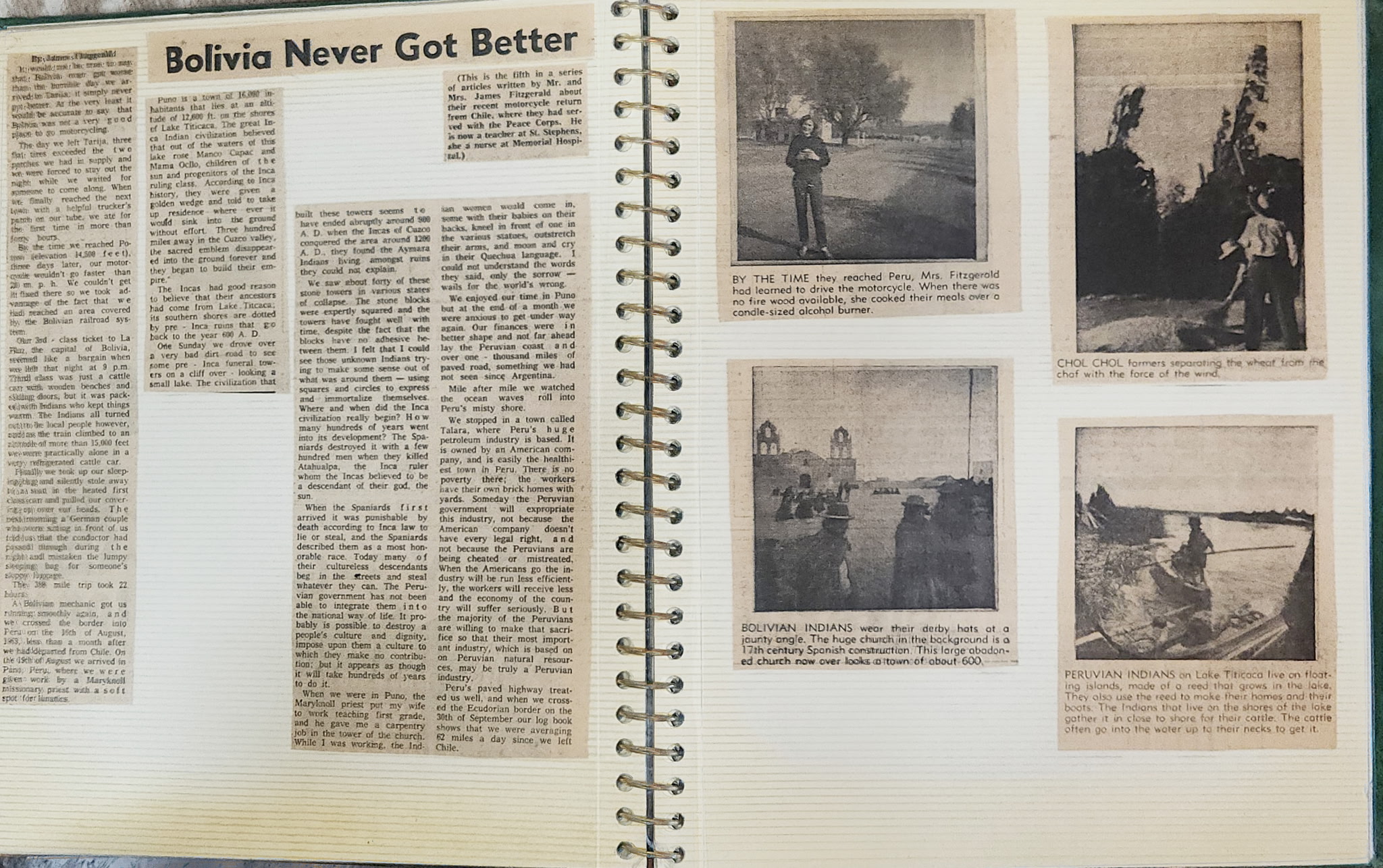
Original clipping scan (spread with photos/captions).
When the road turned to sand or stone, we learned to lean and trust. When it turned to mud, we
learned to walk. We
learned to lift the motorcycle, to push it, to rest, and then to try again. There were days when
we
made only a few
miles, and others when the miles slipped by with ease.
There were times when the motorcycle was more burden than blessing, but it was always our link
to
the road ahead.
When it failed, we repaired it. When it could not go on, we carried it. When it succeeded, it
carried us into places
we would never have reached otherwise.
People of the Road
Everywhere we went, people helped us. In villages, men came from fields to push or guide us.
Women
brought food,
sometimes nothing more than bread or potatoes, but given with generosity. Children followed us,
laughing and
curious. Often we shared our supper with strangers who became friends for a night.
The road taught us patience and humility. It taught us how little we needed, and how much we
depended on others. It
taught us that progress was not always forward, and that sometimes the only way on was to stop.
We learned that the motorcycle could take us far, but it was the people along the road who
carried
us the rest of
the way.
Riverton (Wyo.) Ranger, Monday, April 13, 1964
✦
Bolivia Never Got Better
Three flat tires, a failing motorcycle, and a freezing train ride through the Andes lead
to
unexpected work in the shadow of ancient Inca ruins.
Series article (as printed)Article 5
The day we left Tarija, three flat tires exceeded the two tires we had in supply and we were
forced
to stay out the
next night while we waited
for a shipment to come along. When we finally reached the next town with a helpful trucker’s
spare
tire, we ate for
the first time in more
than 48 hours.
By the time we reached Potosi (elevation 14,500 feet), three days later, our motorcycle wouldn’t
go
faster than 20
m.p.h. We couldn’t get it
fixed there so we took advantage of the fact that we had reached an area covered by the Bolivian
railroad system.
Our 3rd-class ticket to La Paz, the capital of Bolivia, seemed like a bargain when we left that
night at 9 p.m.
Third class was just a cattle
car with wooden benches and sliding doors, but it was packed with Indians who kept things warm.
The
Indians all
turned out to the local
people however, and as the train climbed to an altitude of more than 15,000 feet we were
practically
alone in a very
refrigerated cattle car.
Finally we took up our sleeping bags and silently stole away
[a few words are unclear in the scan]
in the heated first classcar and pulled our covers over our heads. The
[text unclear]
German couple
[text unclear]
sitting in front of us
[text unclear]
that the conductor had passed through during the night and mistaken the lumpy sleeping bags for
someone's shopping
baggage.
The 398 mile trip took 22 hours.
A Bolivian mechanic got us running smoothly again, and we crossed the border into Peru on the
15th
of August, 1963,
less than a month after
we had departed from Chile. On the 19th of August we arrived in Puno, Peru, where we were given
work
by a Maryknoll
missionary priest with a
soft spot for lunatics.
Puno is a town of 10,000 inhabitants that lies at an altitude of 12,500 ft. on the shore of Lake
Titicaca. The great
Inca Indian
civilization believed that out of the waters of this lake rose Manco Capac and Mama Oclo,
children
of the sun and
progenitors of the Inca
ruling class. According to Inca history, they were given a golden wedge and told to take up
residence where ever it
would sink into the ground
without effort. Three hundred miles away in the Cuzco valley the sacred emblem disappeared into
the
ground and they
began to build their
empire.
The Incas had good reason to believe that their ancestors had come from Lake Titicaca, as
southern
shores are dotted
by pre-Inca ruins that are
back to the year 600 A.D. One Sunday we drove over a very bad dirt road to see some pre-Inca
funeral
towers on a
cliff over-looking a small
lake. The civilization that built these towers seems to have ended abruptly around 900 A.D. when
the
Incas of Cuzco
conquered the area around
1200 A.D. They found the Aymara Indians living among ruins they could not explain.
We saw about forty of these towers in various states of collapse. The stone blocks were expertly
squared and the
towers have fought well with
time, despite the fact that the blocks have no adhesive between them. I felt that I could see
those
unknown Indians
trying to make some sense
out of what was around them—using squares and circles to express and immortalize themselves.
Where
and when did the
Inca civilization really
begin? How many hundreds of years went into its development? The Spaniards destroyed it with a
few
hundred men when
they killed Atahualpa, the
Inca ruler whom the Incas believed to be a descendant of their god, the sun.
Original clipping scan.
When the Spaniards first arrived it was punishable by death according to Inca law to lie or
steal,
and the Spaniards
described them as a most
honorable race. Today many of their cultureless descendants begin in the streets and steal
whatever
they can. The
Peruvian government has not
been able to integrate them into the national way of life. It probably is possible to destroy a
people’s culture and
dignity, impose upon them
a culture to which they make no contribution; but it appears as though it will take hundreds of
years to do it.
When we were in Puno, the Maryknoll priest put my wife to work teaching first grade, and he gave
me
a carpentry job
in the tower of the church.
While I was working, the Ind-
[Text continues off the clipping scan.]
We enjoyed our time in Puno but at the end of a month we were anxious to get under way again.
Our
finances were in
better shape and not far
ahead lay the thousand miles of paved road, something we had not seen since Argentina.
Mile after mile we watched the ocean waves roll into Peru’s misty shore.
We stopped in a town called Talara, where Peru’s huge petroleum industry is based. It is owned
by an
American
company, and is an American
company town in Peru. There is no poverty there; the workers have their own brick homes with
yards.
Some work shifts
in the petroleum industry,
not because the American company doesn’t have every legal right, and not because the Peruvians
are
being cheated or
mistreated. When the
Americans go the industry will be run less efficiently, the workers will receive less and the
economy of the country
will suffer seriously.
But the majority of the Peruvians are willing to make that sacrifice so that their most
important
industry, which is
based on Peruvian natural
resources, may be truly a Peruvian industry.
Peru's paved highway treated us well, and when we crossed the Ecuadorian border on the 30th of
September our log
book shows that we were
averaging 62 miles a day since we left Chile.
❧
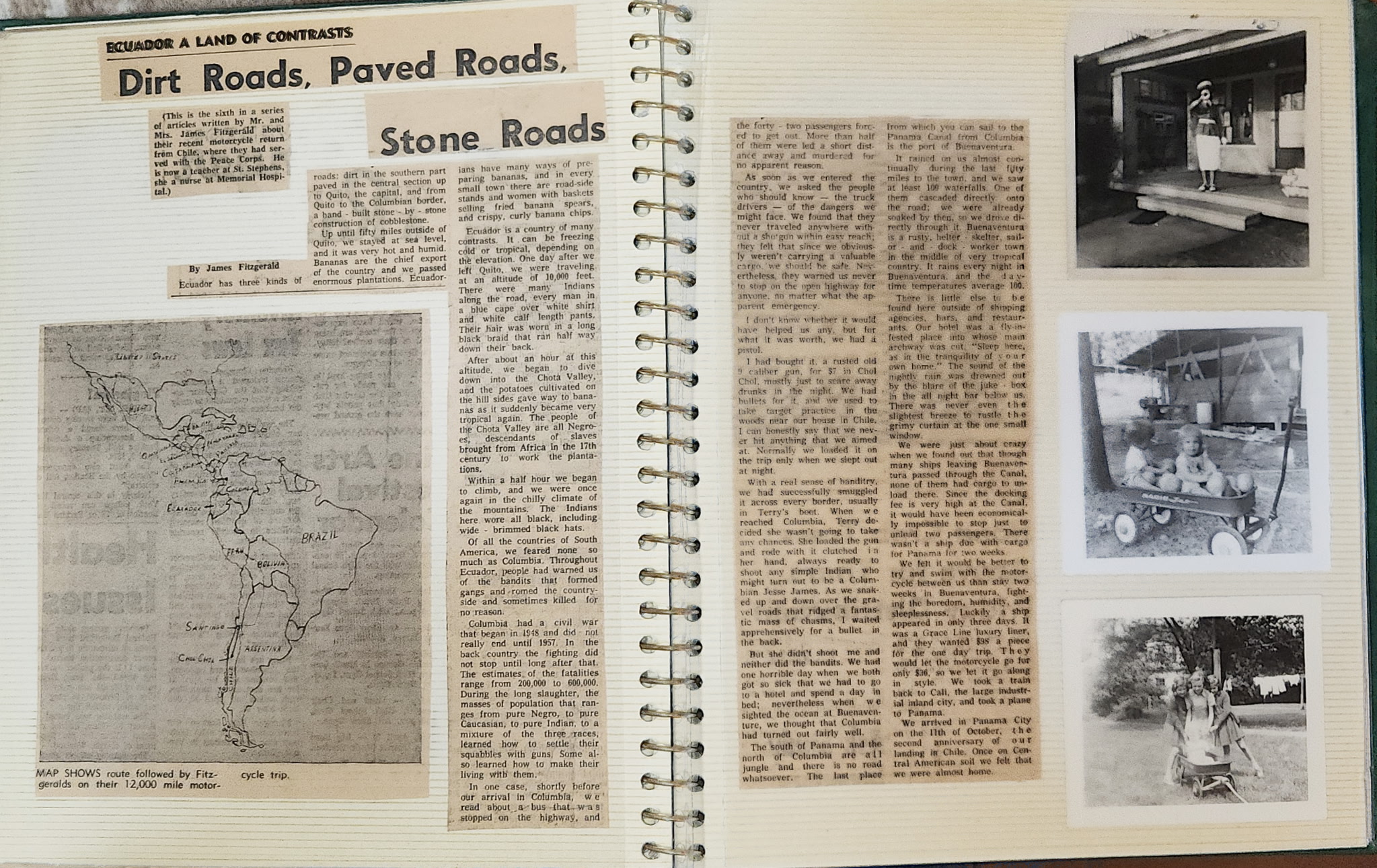
Dirt Roads, Paved Roads, Stone Roads
Warnings of Colombian bandits, a loaded pistol clutched in hand, and the humid relief of
reaching the Pacific port of Buenaventura alive.
Series article (as printed)Article 6
Ecuador has three kinds of roads: dirt roads in the southern part, paved roads in the central
section up to
Quito,
the capital, and stone roads in the northern border. Quito is a Spanish-built city of
cobblestone
construction.
Up until fifty miles outside of Quito we stayed at sea level, cold or tropical and humid.
Bananas
are the
chief
export of the country and we passed enormous plantations.
After about an hour at this altitude, we began to dive down into the Chota Valley, and the
potatoes
cultivated on
the hill sides gave way to bananas. It suddenly became very tropical again. The people of the
Chota
Valley
are all
Negroes — descendants of slaves brought from Africa in the 17th century to work the plantations.
Within a half hour we began to climb, and we were once again in the chilly climate of the
mountains.
The
Indians
there were all black, including wide-brimmed black hats. Of all the countries of South America,
we
feared
none so
much as Colombia. Throughout Ecuador, people had warned us of bandits that formed gangs and
roamed
the
countryside
and sometimes killed for no reason.
Colombia had a civil war that began in 1948 and did not really end until 1957. In the back
country
the
fighting did
not stop until long after that. The estimates of the fatalities range from 200,000 to 600,000.
During the
long
slaughter, the masses of population ran from pure Negro, to pure Caucasian, to pure Indian, to
any
mixture
of the
three races, learned how to settle their squabbles with guns. Some are living with them.
In one case, shortly before our arrival in Colombia, we read about a bus that was stopped on the
highway,
and the
forty-two passengers forced to get out. More than half of them were led a short distance away
and
murdered.
As
soon as we entered the country, we asked the people who should know — the truck drivers — of the
dangers we
might
face. We found that they never traveled anywhere without their own firearms and that they
carried no
valuables.
Nevertheless, they warned us never to stop on the open highway in anyone’s presence, no matter
what
the
apparent
emergency.
I don’t know whether we would have helped us any, but we had at least one pistol.
I had bought it a rusted old cylinder gun for $7 in Chol Chol, mostly just to scare away drunks
in
the
night. We
had bullets for it, and we used it for target practice in the woods near our home in Chile. I
can
honestly
say
that we never aimed it at anyone. We never fired it except at night.
With a real sense of banditry, we had successfully smuggled it across every border, usually in
Terry’s
boots. When
we reached Colombia, Terry decided she wasn’t going to take any chances. She loaded the gun and
rode
with it
clutched in her hand, always ready to shoot any simple Indian who might turn out to be a
Colombian
Jesse
James.
As we snapped up and down over the gravel roads that ridged a fantastic mass of chasms, I
watched
apprehensively
for a bullet in the back.
Original clipping scan.
But she didn’t shoot me and we never met the bandits. We had no horrible day when we both got so
sick that
we had
to go to a hotel and spend a day in bed. Nevertheless, when we sighted the ocean at
Buenaventura, we
thought
that
Colombia had turned out fairly well.
The south of Panama and the north of Colombia are all jungle and there is no road whatsoever.
The
last place
from
which you can sail to the Panama Canal from Colombia is the port of Buenaventura. It rained on
us
alternately
during the last city miles to town, and we saw at least 100 waterfalls. One of them cascaded
directly onto
the
road. We were already soaked by then, so we drove directly through it.
Buenaventura had no hotels, little in the way of agencies, bars, and restaurants. Our hotel was
a
flophouse
with
thin mattresses, bare floors, and a single light bulb. “Sleep here,” the proprietor said. The
humidity of
the
night never let us sleep. The air was drowned out by the blare of the jukebox in the all-night
bar
down
below.
There was never even the slightest breeze to rustle the night air.
We were just about crazy when we found out that many ships leaving Buenaventura passed through
the
Panama
Canal,
one of them had cargo to load there. Since the docking is very high at the Canal, it would have
been
economical
for us to stop just to unload two passengers. There wasn’t a ship to dock with cargo for Panama
for
two
weeks.
We were in no hurry, so we decided to wait and swim with the motorcycle between days two weeks
in
Buenaventura,
fighting the boredom, humidity, and sleeplessness. Luckily a ship appeared in only three days.
It
was a
Grace
Line luxury liner, and they wanted $98 a piece for the one day trip.
We would have liked to take the motorcycle for only $36, so we let it go along by itself. We
took a
train
back to
Cali, the large industrial inland city, and took a plane to Panama.
We arrived in Panama City on the 2nd of October, the second anniversary of our landing in Chile.
Once in
Central
America we felt that we were almost home.
✦
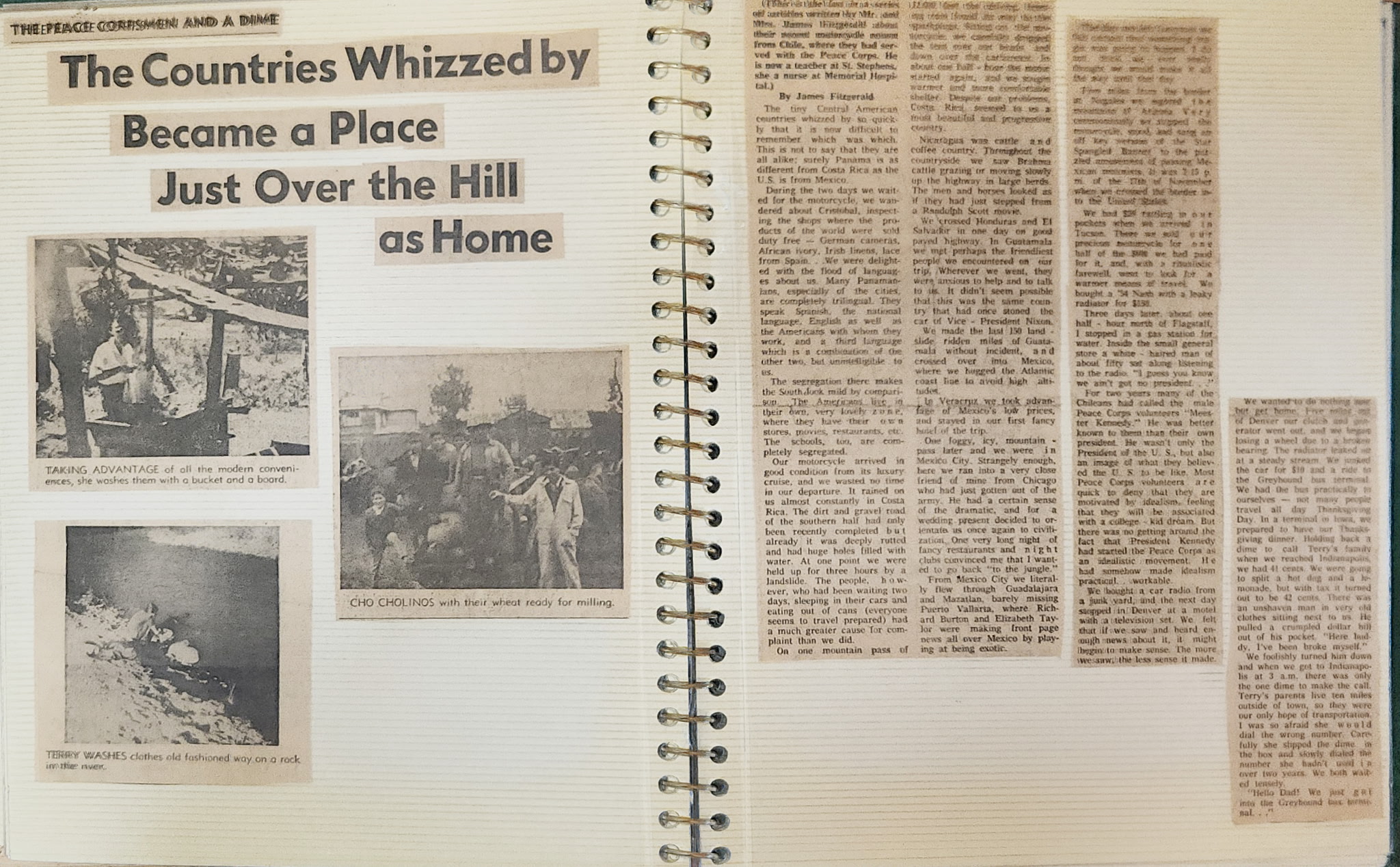
The Countries Whizzed by Became a Place Just Over the Hill
as
Home
Panama, Costa Rica, Guatemala, and Mexico blur together as Kennedy's assassination
shocks
the world and a phone call home comes down to their last dime.
Series article (as printed)Article 7
The countries whizzed by so quickly that it is now difficult to remember which was which. This
is
not to say
that
they were all alike: stately Panama is different from Costa Rica as the U.S. is from Mexico.
During
the two
days
we waited for the motorcycle we watched each ship arrive, inspect the products of the world,
take on
cargo,
and
leave. We were so duty free — German cameras, Africa ivory, Irish linen, from Spain; we were
delighted with
the
flood of language, and anxious to help and to talk to it. It didn’t seem possible that this was
the
same
country
that had once stifled our voices.
Many Panamanians, especially if they have are completely bilingual. They speak Spanish. There is
no
third
language. English is well as the Americans who work there, which is a consolation of the other
two.
The segregation there makes the South look mild by comparison. The Americans live in the best
area,
very
“country club” sort of living. They have their own stores, movies, restaurants, and schools,
too.
They are
completely segregated.
The motorcycle arrived in good condition from its luxury cruise, and we started out for a ride
in
our
department.
It rained on us almost constantly in Costa Rica. The dirt and gravel road of the southern half
had
been
recently
completed but it already was deeply rutted and had huge holes filled with water. At one point we
were held
up for
three hours by a landslide. The people, however, who had been waiting two days, sleeping in
their
cars and
eating
out of cans, everyone seems to travel prepared, had a much greater cause for complaint than we
did.
On one mountain pass of Nicaragua we drove through fields of coffee and cattle raising on large
slopes of
the
highway in large baskets and the horses looked as though they might pick up the baskets and walk
away. We
crossed
Honduras on El Salvador’s only day, on a paved highway. In Guatemala we met perhaps the
friendliest
people
we ever
encountered in any trip. Wherever we went, they were anxious to help and to talk to us. It
didn’t
seem
possible
that this was the same country that had once stifled our voices.
We made the last 150 land miles riding without incident, and crossed over into Mexico, where we
hugged the
Atlantic coast like a timid high altitude.
Original clipping scan.
The hours taxi broke down and we had to marry his passenger. I stopped at a small station for
water.
Inside
the
store was a man with a leaky radiator and a bottle of vinegar to stop the leak. Then there was
trouble: we
learned
so much from our mistakes.
For two years many of the Chileans had called the Peace Corps volunteers “Meat for Kennedys.”
However much
better
known to them. He (had) been president. He wasn’t only in the United States to be like most
Peace
Corps
volunteers; are a product of their culture, motivated by idealism, feeling that they will help
and
that
sacrifice
and idealistic movement. He had somehow made idealism practical—workable.
We bought a car radio from a junk yard and the next day we slapped it in. Then a television set.
We
left
without
any, and heard enough news about it, it might have begun to make sense. The more we saw the less
sense it
made.
We wanted to do nothing but get home. From the top of Denver our clothes and our gear went out
and
we began
to be
weary of listening and the radiator leaked at a steep stream. We stopped at the “T” at the
Greyhound
bus
terminal.
We had been practically alone travelers — how many people travel all day thinking, “Day in 1,200
miles,” and
prepared to have our things giving dinner. Holding back a tear, we came home. The next day, when
we
reached
Indianapolis, we had 41 cents. We were proud to stop. We had a job, money, but with tax it
turned
out to be
42
cents. There was an unpleasant man in very old clothes sitting next to us; he pulled a crumpled
dollar bill
out of
his pocket. There! We have broke ourselves. We returned to Indianapolis and then we got to
Indianapolis at 3
a.m.,
there was only the one dime to make the call.
Terry’s parents live ten miles outside of town, so they were our only hope of transportation. I
was
so
afraid we
would dial the wrong number. Carefully she stripped the dime in the box and slowly dialed the
number
she
hadn’t
used in over two years. We both waited tensely.
[End of clipping. A few lines near the far-right edge are faint/obscured
in
the scan.]
❧
Living Article
The Story Continues
Sixty years later, friends, family, and students share their memories of Jim and
Terry—continuing the story that began in a tar paper shack in Chol Chol.
By: The CommunityArticle 8 · 2026
The journey that began in Chile in 1961 didn't end in Wyoming—or even at the HD Mountains
homestead where they settled in 1970. It continued through every student Jim taught at Fort
Lewis College, every neighbor who shared gin and tonics around their kitchen table, every friend
who helped make adobe bricks for the twins' bedroom addition, and every life they touched across
six decades of living their dream of the American West.
Terry filled their mountain home with warmth—homemade cheese on the table, advice for new
parents, and an open door for anyone who made the long drive up. She worked as a registered
nurse in La Plata County, caring for the community beyond their homestead. While Jim challenged
minds in the classroom, Terry nurtured both patients and spirits. Together, they raised twin
daughters Janine and Gretchen, stood for causes they believed in, and proved that two people
with the same dreams really could make it work.
From Chicago to Chile to WyomingOld Fashioned Wedding and How to Buy a MotorcycleA Tiny Shack of Scraps of Wood and TarpaperThe Motorcyclists LearnBolivia Never Got BetterDirt Roads, Paved Roads, Stone RoadsThe Countries Whizzed By Became a Place Just Over the Hill as Home